
Cutting through the noise
My daughter is afraid of spending money.
And I don’t mean just the big stuff (laptop, phone etc), she hates spending money on anything, even a cup of coffee.
She’s just started at university and has to budget for the first time in her life.
She’ll be fine.
She might be the only student who comes back at Christmas with money in her bank account.
But she told me the other day that when I retired (10 years ago), she thought that we had no money.
That we’d have to sell our home. That she’d lose everything.
No wonder she’s scared to spend money. I had no idea.
And I did this to her.
A Life of Leisure
When I retired, my main emotion was one of relief.
Thank god for that. All the arguing, all the travelling, all the meetings, all the late nights, all those hours away from my family. All that stress - gone.
And it was a wonderful feeling.
I mean we’ve all wanted to tell our boss to fuck off. He can take his job and shove it up his arse., right?
It wasn’t quite like that of course. I was the boss. But still.
I spent a few wonderful weeks doing nothing. Getting used to doing nothing. Turns out I’m pretty good at it.
Then it started.
A nagging doubt at the back of my mind. Something distracting me from my life of leisure. I couldn’t identify what it was for a bit. But I was definitely feeling stressed again.
Weird.
Maybe it was the consistent slice that I couldn’t shake from my golf game?
Maybe it was an urge to get back to work and actually DO something (er, no, that wasn’t it…😂 😂 😂).
Then one day, a glance at my bank account and reality smacked me in the face.
My bank account will only ever have money going OUT from now on. The totals moving slowly (or not so slowly) downwards. Forever.
Shit.
I needed to think about this.
I’m a big fan of dying with zero. No point in saving for a life after death. But unless I was going to be dead by 45, then things had to change.
So I became obsessed.
Money management. Investing. Cash.
Spreadsheets
...became
...my
...life.
Again.
I’d gone from running a private equity business to managing my own money/savings. And I approached it the exact same way. I was ruthless. It was all I did. It was all I talked about.
I did research into fund management businesses. I spoke to everyone in my network. I became an expert.
I might as well have been back at work.
And I checked on everything religiously. Hourly. I was paranoid about running out of money.
Mother, dearest
My Mother is not a professional investor.
For those of you who’ve met her, this will come as no surprise.
Yet she does buy and sell shares. So I guess she’s an investor (of sorts).
Like me back then, she checks how much money she’s ‘made’ or ‘lost’ on her shares on an hourly basis. Maybe it’s just a Kaye thing?
But I suspect a lot of people (amateur and professional investors alike) do the exact same thing.
And it’s almost the exact opposite of how you should behave.
The problem is that our emotions follow a similar path to the share prices.
Up or down. Happy or sad. Winner or loser.
And this emotional rollercoaster makes you a bad investor, prone to making short term decisions.
It's also a shit way to spend your days. Stressful and pointless.
You see, t-he longer you hold onto shares the more likely you are to make money. A ten year investment horizon more or less guarantees you a profit.
For example, 88% of every 10 year period since 1871 has made you a profit:
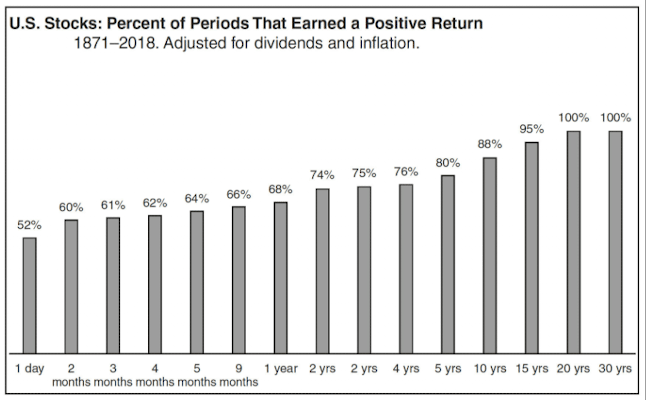
So over a ten year period, you're more or less guaranteed to make money.
If you checked your investments once every ten years, you’d be pretty pleased with life.
But if you checked your investments every hour, that’s 613,200 data points over ten years.
The only data you really care about is the long term 10 year trend.
But how many of those 600,000+ points of data are going to be consistent with the long term “real” trend, and how many are just noise?
Share prices go up because good businesses make above average returns and choose to reinvest any surplus cash back into the business.
This compounding effect can make you a lot of money if you just hang around long enough.
But share prices also go up and down because:
- Trump says something stupid
- inflation isn’t what somebody thought it was going to be
- a great company made slightly less money than some 29 year old analyst predicted
- people get scared
- people forget to be scared
- some dictator gets bored and invades another country
- the weather is a bit wetter than the long term average
- etc etc etc
You need to try to see the signal (the valuable part of the data) and ignore the noise.
And the more data you have, the harder it is to do that.
Signal vs Noise
If you check share prices once a year and let’s assume at that frequency the ratio of signal (good) to noise (useless) is one-to-one, then half the changes you see are real price moves (up or down) and half are random.
But if you look at the same data on a daily basis, then 95% of the data you look at is noise and only 5% signal.
And on an hourly basis, it goes to 99.5% noise and 0.5% signal. That is 200 times more noise than signal.
Of course, when you’re looking at it, you don’t know which share price move is just noise and which is a true signal.
The lesson here is to search for the signal. Spend your time making good decisions and ignore the noise.
OK. That’s fine you may be thinking but how do you actually do that? Especially when you don’t know which is which.
The answer is time.
Most great things in life - from love to careers to investing - gain their value from patience. From allowing something the time to flourish.
But what is the most common tactic when people find something great and pursue it aggressively? Trying to make it bigger and faster.
This ‘slow’ approach can be applied to almost every aspect of your life.
If you’re trying to lose weight, weighing yourself once a month would give you better data than weighing yourself everyday. And provide a more realistic time frame for change.
Check your investments once a quarter, maybe even less.
Read the news, but not every day.
And guess what? Less noise means less stress. Less worrying about things that don’t matter.
I’m much more relaxed about running out of money these days. I try not to think about it. I try to make sensible investments decisions and then wait it out.
I’m also more aware that my actions influence those around me.
I’ve always wondered what lessons I can teach my kids. What can I tell them, to prepare them for their life ahead?
I’d love to be one of those families where the kids remember their childhood fondly, recalling Dad’s favourite sayings (e.g. Dad always said “Carbs will kill you” or “Cyclists deserve to die”).
But we’re not like that.
Now that doesn’t mean my kids haven’t learned anything from me. My daughter is running a budgeting spreadsheet as a student and her accountant Dad couldn’t be more proud.
But the paranoia and insecurities that came from jolting her from a life of comfort and safety, well, they’re my legacy too.
And I can’t change that.
Jon "the Tortoise not the Hare" Kaye
Original newsletter disclosures
DISCLAIMERS & DISCLOSURES This content is for education and entertainment purposes only. Jon does not provide tax or investment advice. The information is being presented without consideration of the investment objectives, risk tolerance, or financial circumstances of any specific investor and might not be suitable for all investors. Past performance is not indicative of future results. All investing involves risk, including the possible loss of principal.